

Uncategorized
Why Enzymatic Cleaners Are Important for Dental Instrument Cleaning
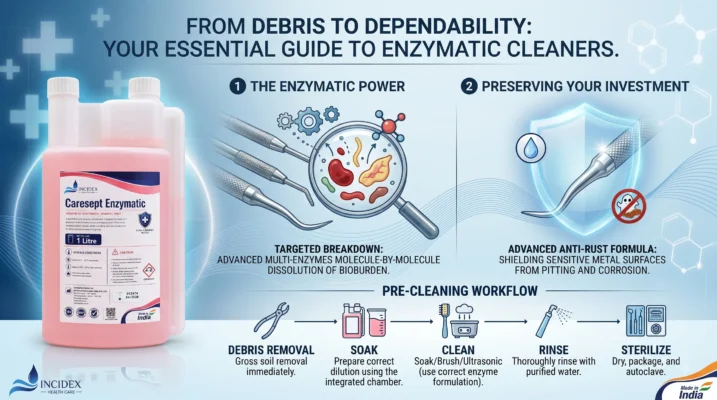
Why Enzymatic Cleaners Are Important for Dental Instrument Cleaning
In every dental practice, maintaining clean and properly reprocessed instruments is an essential part of safe patient care. Dental instruments can come into contact with blood, saliva, tissue, and other organic debris during procedures. If this contamination is allowed to dry on the instrument, it can become more difficult to remove and may interfere with subsequent disinfection or sterilization.
This is why effective dental cleaning instruments protocols begin with thorough cleaning. Enzymatic cleaners can be an important part of this stage, helping loosen and break down organic residues before instruments move to the next steps of the reprocessing cycle.
One such solution available through DentalCall is Caresept Enzymatic, a dental instrument cleaning product listed under DentalCall’s cross-infection-control range.
What Is an Enzymatic Cleaner?
An enzymatic cleaner is a cleaning solution formulated with enzymes that help break down organic materials found on contaminated instruments. Depending on the formulation, enzymes can target substances such as proteins, fats, and carbohydrates.
The CDC explains that cleaning is the removal of foreign material and organic matter from instruments and that water with detergents or enzymatic products can be used for this purpose. Enzymatic formulations commonly use enzymes such as proteases, lipases, and amylases to assist with organic soil removal.
Importantly, an enzymatic cleaner is not a substitute for sterilization. Its role is to support the cleaning stage so that instruments can subsequently undergo the appropriate disinfection or sterilization process.
Why Is Cleaning Dental Instruments So Important?
Cleaning is the foundation of instrument reprocessing.
Blood, saliva, tissue debris, and other contaminants can remain on instruments after a dental procedure. If this material dries onto the surface, it becomes harder to remove. Organic material can also interfere with the effectiveness of subsequent disinfection or sterilization.
For this reason, the CDC recommends cleaning reusable dental instruments before disinfection or sterilization and emphasizes following the manufacturer’s validated instructions for reprocessing.
A consistent cleaning process helps prepare instruments for the next stage of reprocessing.
How Do Enzymatic Cleaners Work?
The basic principle is straightforward.
Organic contamination contains different types of molecules. Enzymes are selected because they can help break down specific components of that contamination.
For example:
- Proteases help break down protein-based residues.
- Lipases act on fats and oils.
- Amylases help break down starch-based material.
The CDC notes that these enzymes can assist with removing organic material from medical instruments.
Once contamination has been loosened and removed, the instrument can be rinsed and prepared for inspection and subsequent reprocessing according to the applicable instructions.
Benefits of Using an Enzymatic Dental Instrument Cleaner
1. Helps Remove Organic Contamination
One of the main advantages of an enzymatic dental instrument cleaner is its ability to assist with removing organic residues such as blood and tissue material.
2. Supports the Reprocessing Workflow
Cleaning is an essential step before sterilization. An effective cleaning process helps prepare reusable instruments for subsequent processing.
3. Helps With Difficult-to-Remove Residues
Organic debris can become increasingly difficult to remove once it dries. Prompt cleaning helps prevent contamination from becoming firmly attached to instrument surfaces.
4. Suitable for Professional Instrument Reprocessing
When the formulation is compatible with the instrument materials and used according to its manufacturer’s instructions, enzymatic cleaning can form part of a structured dental instrument reprocessing workflow.
5. Helps Maintain Instrument Care
Appropriate cleaning products and procedures can support the ongoing care of reusable instruments. However, compatibility, concentration, exposure time, temperature, and rinsing requirements should always be determined from the product and instrument manufacturer’s instructions.
Enzymatic Cleaning vs. Sterilization: What’s the Difference?
This is one of the most important points for dental professionals to understand.
Enzymatic cleaning removes contamination. Sterilization is a separate process designed to eliminate viable microorganisms.
The two should not be treated as interchangeable.
The CDC states that cleaning should occur before disinfection or sterilization because remaining blood, saliva, and other organic material can shield microorganisms and compromise the effectiveness of subsequent processing.
For dental instruments classified as critical, such as instruments that penetrate soft tissue or bone, heat sterilization is recommended when appropriate.
Therefore, using an enzymatic cleaner does not mean an instrument is sterile.
How Should Dental Instruments Be Cleaned?
A dental practice should establish a consistent instrument-reprocessing workflow based on current infection-control recommendations and the manufacturer’s instructions.
A typical process may involve:
- Safely contain and transport contaminated instruments.
- Begin cleaning as soon as practical to prevent debris from drying.
- Use the appropriate detergent or enzymatic cleaner according to its instructions.
- Perform manual or mechanical cleaning as appropriate.
- Rinse instruments thoroughly to remove cleaning residues.
- Inspect instruments for remaining debris or damage.
- Dry and package instruments as required.
- Perform the appropriate sterilization or disinfection process.
The CDC recommends using automated cleaning equipment, such as ultrasonic cleaners or washer-disinfectors, where appropriate because these systems can improve cleaning efficiency and reduce occupational exposure to contaminated instruments.
Choosing the Right Dental Instrument Cleaner
When selecting an enzymatic cleaner, dental practices should consider more than simply the price.
Important factors include:
- Compatibility with instrument materials
- Enzyme formulation
- Recommended dilution
- Required contact time
- Temperature requirements
- Compatibility with ultrasonic or automated cleaning systems
- Rinsing requirements
- Manufacturer’s instructions
- Packaging and product size
- Intended clinical application
The CDC specifically recommends ensuring that selected detergents or enzymatic cleaners are compatible with the metals and other materials used in medical instruments.
Caresept Enzymatic from DentalCall
For dental professionals looking for an enzymatic cleaning solution, Caresept Enzymatic is available through DentalCall’s cross-infection-control category. DentalCall currently lists the product as Caresept Enzymatic and provides it alongside other instrument cleaning and disinfection products.
Before using any enzymatic product, dental professionals should review its current label and Instructions for Use (IFU), including dilution, contact time, temperature, compatibility, rinsing, and any other handling requirements.
Explore Caresept Enzymatic on DentalCall
Common Mistakes to Avoid
Even a good cleaning product cannot replace a proper reprocessing protocol.
Avoid:
- Allowing contaminated debris to dry unnecessarily.
- Using the wrong dilution.
- Exceeding or ignoring the recommended contact time.
- Skipping the rinse step.
- Assuming enzymatic cleaning equals sterilization.
- Using a product without checking instrument compatibility.
- Reprocessing instruments without following the manufacturer’s IFU.
The CDC emphasizes that dental instrument reprocessing procedures should be performed correctly and in the proper sequence every time.
Final Thoughts
Effective dental cleaning begins with a reliable and consistent approach to cleaning dental instruments. Enzymatic cleaners can help loosen and remove organic contamination, making them a valuable component of instrument reprocessing when used correctly.
However, the most important principle is to view enzymatic cleaning as one step in the overall process, not as a replacement for sterilization or disinfection.
For dental professionals in India, DentalCall provides access to products such as Caresept Enzymatic as part of its cross-infection-control range. Choosing an appropriate dental instrument cleaner, following the manufacturer’s instructions, and maintaining a consistent reprocessing workflow can help dental practices support effective instrument care and safer clinical operations.
Frequently Asked Questions
1. What is an enzymatic cleaner for dental instruments?
An enzymatic cleaner is a cleaning solution containing enzymes that help break down organic contamination such as proteins, fats, and carbohydrates on reusable instruments.
2. Why are enzymatic cleaners used for cleaning dental instruments?
They help loosen and remove organic debris before subsequent disinfection or sterilization. Cleaning is important because residual contamination can interfere with later reprocessing steps.
3. Is an enzymatic cleaner the same as a disinfectant?
No. An enzymatic cleaner is primarily intended for cleaning and removing contamination. It should not automatically be considered a disinfectant or sterilant.
4. Can enzymatic cleaners replace sterilization?
No. Enzymatic cleaning and sterilization are different steps. Instruments requiring sterilization must undergo the appropriate validated sterilization process after cleaning.
5. How should an enzymatic dental instrument cleaner be used?
Always follow the product manufacturer’s current Instructions for Use, including the recommended dilution, contact time, temperature, compatibility requirements, and rinsing procedure.
6. What is Caresept Enzymatic?
Caresept Enzymatic is an enzymatic cleaning product listed by DentalCall within its cross-infection-control product range for dental practices.
7. Why should dental instruments be cleaned quickly after use?
Prompt cleaning helps prevent blood, tissue, and other organic debris from drying onto instruments. Dried contamination can be more difficult to remove and may interfere with subsequent disinfection or sterilization.
8. Where can dentists buy Caresept Enzymatic online in India?
Dental professionals can explore Caresept Enzymatic through DentalCall’s online dental supply platform.
